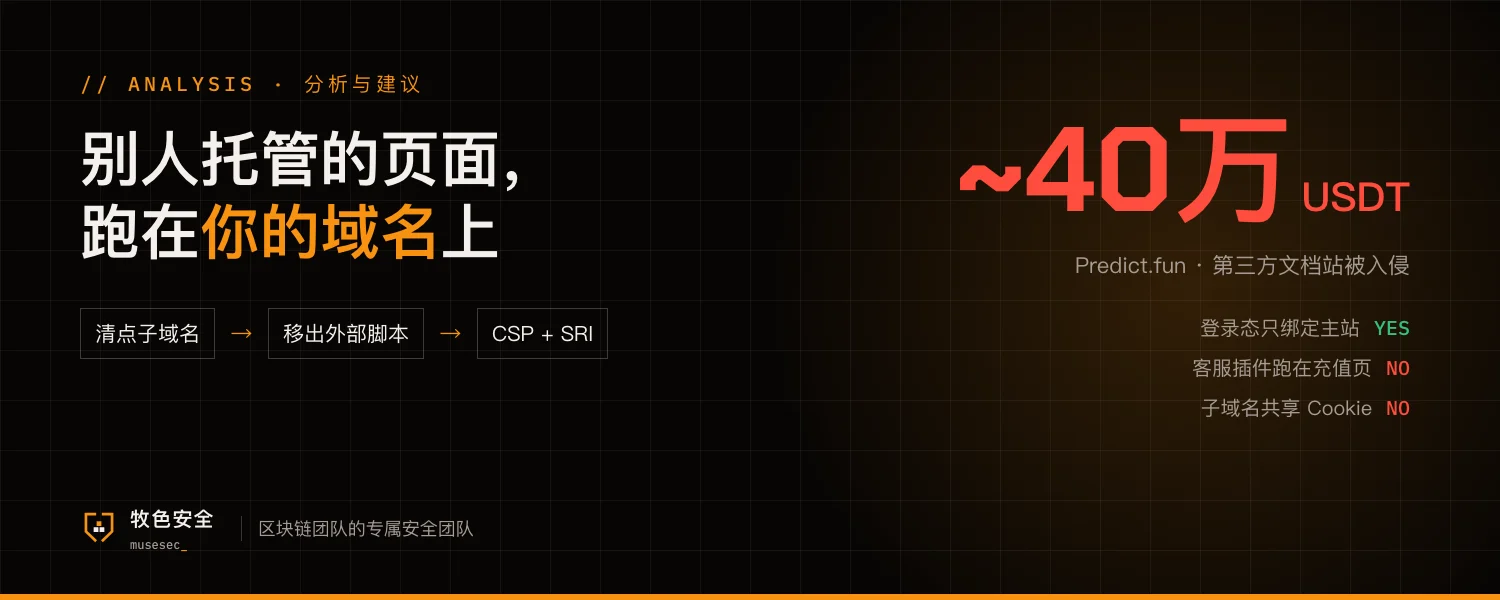
On October 27, BNB Chain prediction market Predict.fun reported unauthorized transfers from a small number of user wallets, totaling about 400,000 USDT. Its preliminary finding points to a compromise of its API documentation site, which is hosted by a third-party provider. The site has been taken offline, affected users will be fully reimbursed, and a post-mortem is pending. According to security researchers, the docs site sat on a subdomain of the main app, so injected script could act through users' logged-in sessions.
The same day, security researchers disclosed that scripts tied to the Udesk customer support widget had been injected with malicious code that collects sessions and form data, and swaps deposit addresses on the deposit pages of three exchanges.
What the two incidents share: the code that failed was not in the team's own repo, yet it ran on the team's own domain.
Where small teams are exposed
Process
Docs sites, support widgets and analytics tags are usually added by marketing or ops, skip security review, and are never revisited.
Risk
Users trust your domain. Once a third-party page or script is altered, the sessions it reads and the deposit addresses it shows may already be under an attacker's control.
Privileges
If subdomains share the main app's login state, or third-party scripts run on deposit and withdrawal pages, one compromised vendor means a compromised frontend.
Five things you can do now
- Inventory who hosts each subdomain and which external JS each page loads
- Keep deposit, withdrawal and signing pages to essential scripts only; move support and analytics widgets off them
- Scope session cookies to the main app host, not to subdomains; put docs and help centers on a separate domain
- Enforce CSP and Subresource Integrity so a changed external script is blocked or alerted on
- Require a second confirmation for withdrawals and address changes, and give users an independent channel to verify deposit addresses
The Predict.fun timeline follows its official announcement; the intrusion method has not been published. The Udesk findings come from security researchers; how the code entered the script and how many sites were affected are not yet public. This article does not cover attack details.
Sources
- Predict.fun official announcement (2026-10-27) ↗
- SlowMist: Threat Intelligence | Udesk Loads Malicious JS to Steal Data and Alter Deposit Addresses (2026-10-27) ↗
- crypto.news: Predict.fun confirms 400,000 USDT theft, promises full refunds ↗
- ChainCatcher: SlowMist on malicious code in Udesk customer service scripts (Chinese) ↗
Also on X · Oct 28, 2026: View the original post on X ↗